
Recently, I was invited by my friend and Chef, Nikolaos Sakellariou, on the show POP Gastronomy to discuss the nutritional value of the mushroom risotto recipe, whose key ingredient was San Michali cheese. How could I possibly turn down such a flavorful invitation?

Let’s explore some facts about this beloved dairy product.
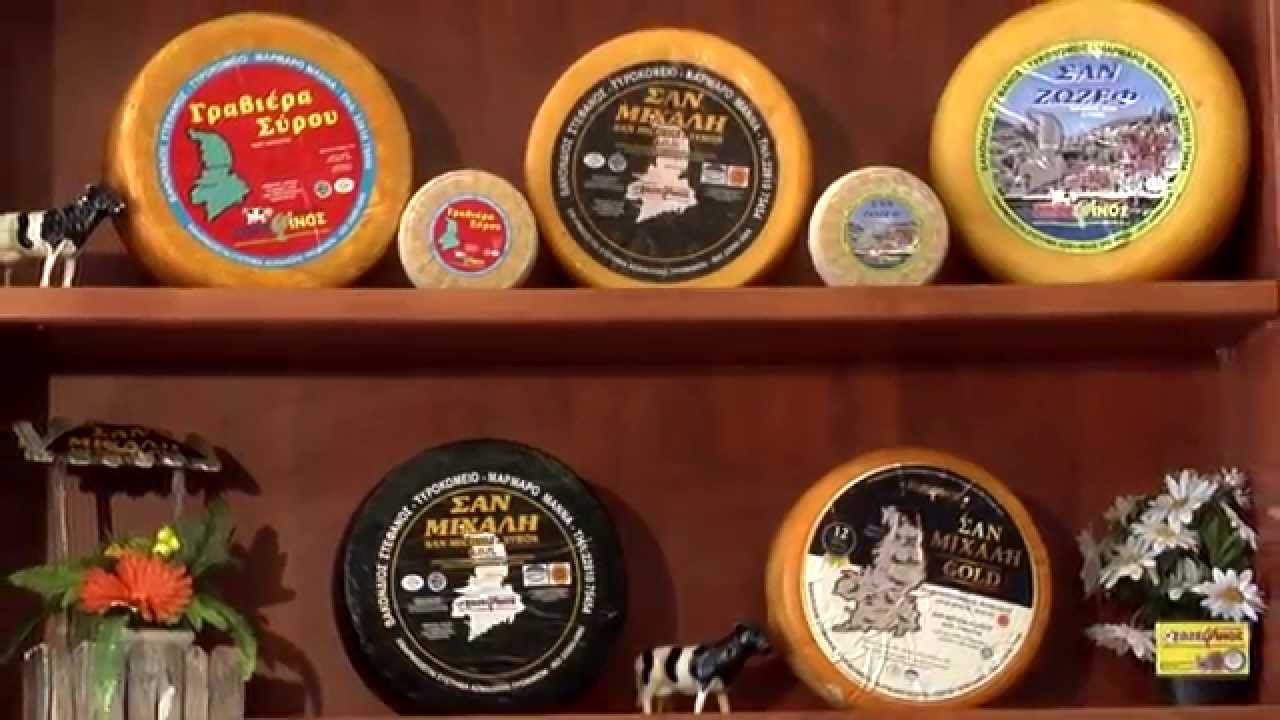
San Michali is a traditional Greek cheese produced on the beautiful and cosmopolitan island of Syros since the early 1970s. Its name derives from a mountain located on the northern side of the island, home to the village of San Michali.
Origin
In 1994, San Michali was recognized as a Protected Designation of Origin (PDO) product. This classification signifies that its quality or characteristics are primarily or exclusively attributed to the geographical environment where it is produced. Furthermore, in compliance with current PDO regulations, the addition of any substances such as colorants, preservatives, or antibiotics is strictly prohibited.
A Local Treasure
San Michali is made exclusively from cow’s milk sourced on the island. The only dairy facility in Syros collaborates with over ten local cattle farmers, producing an average of 46 tons of this product annually.
Keep in mind that it takes approximately 12 liters of milk to produce just one kilogram of cheese!
San Michali boasts a golden hue and a distinctively salty, spicy flavor. It can be enjoyed in various ways: as a table cheese accompanying main dishes, incorporated into numerous recipes, or even as a snack paired with a glass of white or light red wine.
Milk Preparation: The process begins with partially skimmed, pasteurized cow's milk.
Coagulation: The milk is coagulated at a temperature of 32–34°C. The resulting curd is then cut, reheated to 48–50°C, lightly salted, transferred into molds, and subjected to strong pressing.
Salting and Maturation: The cheese is salted by immersing it in brine at a temperature of 10–14°C for approximately 12 days. It is then moved to maturation chambers with a temperature of 14–16°C and relative humidity of about 85%, where it remains for at least four months.
San Michali cheese has a cylindrical shape and a hard texture with small, irregular holes. When cut, it tends to crumble, much like Parmesan.
Moisture Content
San Michali contains a maximum moisture content of 40%, classifying it as a hard cheese.
Cheese Categories by Moisture Content:
Soft cheeses in this category are consumed within a few days of production if unripened or within a few weeks if ripened. They retain a significant amount of whey, which contributes to their high moisture content.
Nutritional Value
100 g of San Michalis cheese contains:
| Energy | 333 Kcal |
| Protein | 33 g (32,5 +/- 1,3 g) |
| Fat | 21,5 g (21,4 +/- 0,3 g) |
| Saturated Fat | 15,2 g |
| Carbohydrates | 2,5 g |
| Salt | 3 g |
| Sodium | 1250 mg (1200 +/- 100 mg) |
Proteins in long-aged cheeses are more digestible. In fact, hard cheeses contain significantly less lactose compared to milk (1-3 g of lactose/100 g of product vs. 13 g in 1 cup of whole milk). As a result, they are often better tolerated even by people with lactose intolerance.
Regarding fat content, this cheese contains approximately 21.5 g of fat per 100 g, placing it in the same category as Feta. It also contains 1250 mg of sodium, or roughly 3 g of salt, which is similar to Halloumi.
During the cheesemaking process, the majority of fat-soluble vitamins are preserved, including:
Some of the key benefits of these nutrients are shown in the following table:
| Nutritional ingredients | Actions |
| Vitamin A |
– Antioxidant action |
| Vitamin D |
– Calcium absorption |
| Calcium |
– Bone building and repair |
| Vitamin B2 (Riboflavin) |
– Energy production |
If you are looking for a cheese to include in your meal, San Michalis is a good option as it has a high protein content while containing less fat compared to other cheeses. It is worth noting, however, that like all cheeses, it does contain cholesterol and may lead to an increase in triglycerides. Additionally, it should be consumed with caution by individuals with hypertension due to its salt content, as is the case with most cheeses.
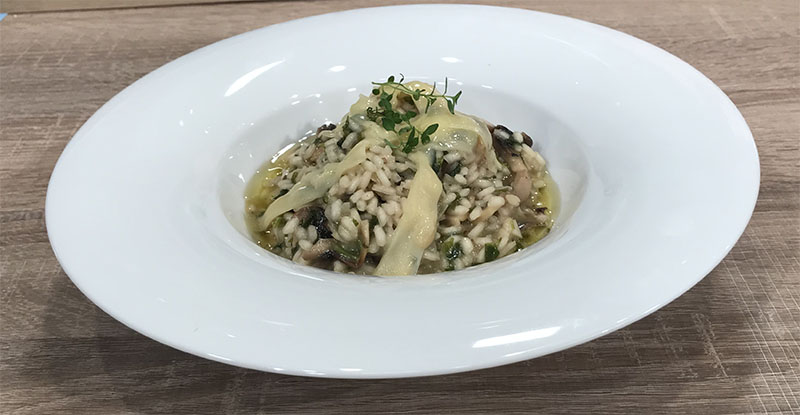
Let's see San Michalis in our recipe.
Recipe Ingredients for 4 servings
For garnish
Instructions
Let's take a look at the ingredients in this recipe and how they nutritionally interact with each other:
Mushrooms
Mushrooms are rich in water, about 90%, making them low in calories. They are also high in dietary fiber, around 8-10%, and provide a good source of protein compared to other plant-based foods. As a result, they contribute significantly to feelings of fullness.When cooking mushrooms, it's important to know that their antioxidants are not destroyed by heat, unlike most vegetables, because they are fungi. Additionally, they enhance the flavor of a dish, so there's no need to add extra salt.
Rice
Arborio rice is of Italian origin. While it doesn't have the same nutritional value as brown rice, it remains a very good source of B vitamins, which participate in the body's metabolic functions and contribute to energy production. Additionally, it contains low-quality protein, which, when paired with cheese, is enhanced.
Cheese
Cheese is the ingredient that provides the highest amount of bioavailable protein, meaning protein that contains all the essential amino acids that our body cannot synthesize but needs. It is also rich in animal fats.Due to its high content of these two macronutrients (protein and fat), cheese helps lower the glycemic load of the meal.
Onion
It may seem surprising, but onion is rich in antioxidant compounds. It also contains inulin, a type of fiber with prebiotic properties, which aids in better digestion of food.
Garlic
Garlic has vasodilatory effects, making it easier for blood to circulate. It helps reduce bad cholesterol levels without affecting good cholesterol levels.
Parsley
Parsley helps expel gases from the body. It also freshens the breath, especially when a dish contains garlic and onion.
Enjoy your meal!
Bibliography
Facebook.com. 2020. Τυροκομείο Ζωζεφίνος. [online] Available at: <https://www.facebook.com/pg/tyrokomeiozozefinos.gr/about/?ref=page_internal> [Accessed 1 June 2020].
Ndb.nal.usda.gov. (2018). Food Composition Databases Show Foods List. Available at: https://ndb.nal.usda.gov/ndb/search/list [Accessed 11 Jun. 2018].
Valverde ME, Hernández-Pérez T, Paredes-López O. Edible mushrooms: improving human health and promoting quality life. Int J Microbiol. 2015;2015:376387.
Environ Int. 2016 Nov;96:139-155. doi: 10.1016/j.envint.2016.09.006. Epub 2016 Sep 17. Arsenic accumulation in rice: Consequences of rice genotypes and management practices to reduce human health risk. Islam S1, Rahman MM2, Islam MR3, Naidu R4.
Better Nutrition magazine, The Stinking Rose, accessed on 4th February 2014: http://www.betternutrition.com/garlic-healing-powers/features/featurearticles/1276.
Belitz ,H,D, Grosch.W., and Scieberle ,P., ( 2009) Food chemistry Springer.
Karimi, M., Ebadi, P., Amirghofran, Z. (2012). Parsley and immunomodulation. Expert Review Of Clinical Immunology, 8(4), 295-297.
Blogstonatmo.blogspot.com. 2020. Ριζότο Με Μανιτάρια Και Σαν Μιχάλη. [online] Available at: <https://blogstonatmo.blogspot.com/2020/09/blog-post_77.html> [Accessed 7 October 2020].